In the emotionally charged space of psychosocial support, self-reflective practice is more than a professional habit—it’s a vital psychological tool. It allows practitioners to tune into their inner world, acknowledge unconscious processes, and make sense of their emotional responses to clients. Grounded in psychoanalytic thought, self-reflection provides a space for processing transference, countertransference, and the complex dynamics that shape therapeutic relationships.

Self-reflective practice refers to the intentional examination of one’s thoughts, feelings, and
behaviours within the therapeutic context. For practitioners, it means noticing when an
emotional response to a client arises and exploring what it reveals about their own inner
world. Psychoanalytic theory emphasizes the unconscious processes that shape our
perceptions and interactions. From this perspective, self-reflection becomes a way to
illuminate blind spots, unresolved conflicts, and past experiences that may influence the
therapist-client relationship.
In psychosocial support, where practitioners often hold space for trauma, grief, or chronic
stress, the reflective process helps prevent emotional entanglement. It also cultivates a deeper
empathic stance, as therapists gain insight into how their personal narratives intersect with
their professional roles.

Defence Mechanisms: Avoiding the Uncomfortable
Engaging in self-reflection can trigger uncomfortable feelings—shame, guilt, envy, or inadequacy. As a result, defence mechanisms often emerge to protect the psyche. A practitioner might rationalise a moment of impatience with a client, intellectualise an emotional reaction, or unconsciously project their own fears onto the client. These defences serve to preserve a sense of professional competence and emotional safety, but can also hinder growth and insight.
In a psychoanalytic context, becoming aware of these defences is not about judgment, but about curiosity. Why did I feel unusually anxious in that session? Why do I dread seeing this particular client? These questions are entry points into a deeper understanding. As Freud suggested, what we resist often holds the key to what we most need to know.
Our ability to reflect on our internal world is shaped by early attachment experiences. Secure attachments in childhood foster a strong capacity for mentalization, that is, the ability to understand one’s own and others’ mental states. Practitioners who grew up in emotionally attuned environments may find self-reflection more natural, whereas those who experienced neglect, criticism, or emotional invalidation might struggle with inner exploration. Additionally, early roles within the family, such as the caretaker child, the peacemaker, or the overachiever, can influence a psychosocial support worker unconscious motivations. A practitioner who learned to suppress their own needs in childhood may find it difficult to acknowledge feelings of burnout or resentment in their work. Without reflection, these emotions can leak into the therapeutic space in disguised or unhelpful ways.
Self-reflection Practices
Self-reflective practice can take many forms. Journaling after sessions allows psychosocial support workers to pause and process emotional responses that may have been triggered. It offers a private, unfiltered space to notice patterns, lingering feelings, or questions that arise. Similarly, participant notes at the end of each session can be more than documentation—they can act as intentional moments of reflection, helping the practitioner consider what emotional dynamics were at play during the session, both for the client and for themselves.
Clinical supervision also plays a crucial role in supporting self-reflection. In supervision, support workers have the opportunity to explore their reactions with the guidance of a more experienced clinician. Through open discussion, supervision can gently surface unconscious material, provide alternative perspectives, and validate the emotional complexities of psychosocial work. Importantly, it creates a relational space where reflective habits can be modelled and nurtured.
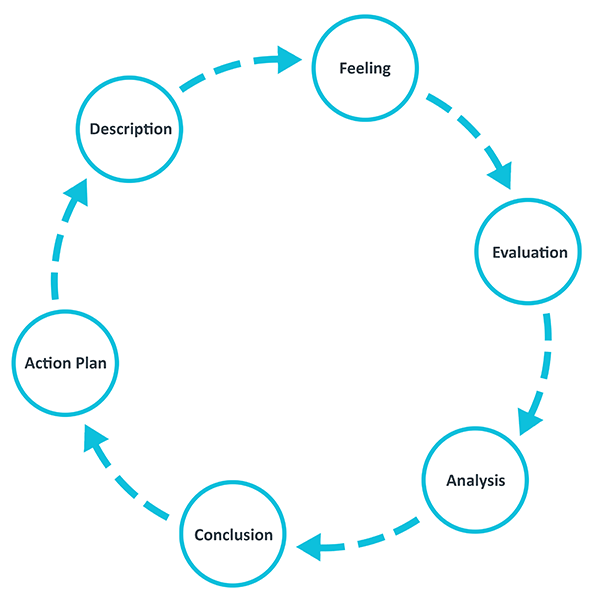
Another technique which can be useful for both practitioners and participants is the Gibbs reflective model. This model examines experiences through six stages. This cyclical model encourages individuals to delve deeply into their experiences, fostering a comprehensive understanding of their actions and reactions. For practitioners, it serves as a valuable tool to systematically reflect on client interactions, identify areas for improvement, and develop strategies for future practice. Participants can also benefit by using the cycle to process their experiences, leading to enhanced self-awareness and personal growth.
Conclusion
In the realm of psychosocial support, where practitioners are repeatedly invited into others’ pain, confusion, and transformation, self-reflective practice acts as a psychological anchor. It allows us to see ourselves more clearly, hold space with greater integrity, and recognise that our internal world is always part of the clinical picture.
Written by Monica Garcia Del Toro (Psychosocial Support worker)
Further Reading
https://pacja.org.au/article/71255-reflective-practice-in-the-art-and-science-of-counselling-a
scoping-review/attachment/148290.pdf
https://pacja.org.au/article/71255-reflective-practice-in-the-art-and-science-of-counselling-a
scoping-review/attachment/148290.pdf
https://reflection.ed.ac.uk/reflectors-toolkit/reflecting-on-experience/gibbs-reflective-cycle
References
counselling and CBT trainees: the self-perceived impact of personal therapy and self
practice/self-reflection on personal and professional development. Cognitive
Behaviour Therapy, 50(5), 422-438. https://doi.org/10.1080/16506073.2020.1846608
Knapp, S., Gottlieb, M. C., & Handelsman, M. M. (2017). Enhancing professionalism
through self-reflection. Professional Psychology: Research and Practice, 48(3), 167.
Mösler, T., Poppek, S., Leonhard, C., & Collet, W. (2023). Reflective Skills, Empathy,
Wellbeing, and Resilience in Cognitive-Behavior Therapy Trainees Participating in
Mindfulness-Based Self-Practice/Self-Reflection. Psychological Reports, 126(6),
2648-2668. https://doi.org/10.1177/00332941221094482
Prasko, J., Mozny, P., Novotny, M., Slepecky, M., & Vyskocilova, J. (2012). Self-reflection in
cognitive behavioural therapy and supervision. Biomedical Papers of the Medical
Faculty of Palacky University in Olomouc, 156(4).
Vyskocilova, J., & Prasko, J. (2013). Ethical reflection and
psychotherapy. Neuroendocrinology Letters, 34(7), 590-600.
https://reflection.ed.ac.uk/reflectors-toolkit/reflecting-on-experience/gibbs-reflective-cycle
COPE Centre of Psychological Enrichment
📞 (08) 6556 6460
📧 [email protected]